
-last modf 1447 AH, 2025-10-24 15:30 +0200, bit.ly/_hegciv [027] index 10min read
By Hasan Spiker, ≈2025-09-04[1]
Quotes are from the 1st chapter of the book [19]
Comments in the footnotes: from the author.[1]
In-line ( ) parentheses: comments by the author.
In-line [ ] brackets: words and interpolations by the webadmin.
On The Pretense of "The Civilisation of Liberal, Universal Modernity, Neutral and Scientific" (COLUMNS).
The Preface begins with:
The intelligibility[22] of Western thought is unravelling, and the same is true of its attendant societal structures; indeed, they are in their final stages of unravelment.
And it is not the case that this has always been so, despite how comforting a thought that might be. In reality, we are now approaching something of a historical singularity, within a civilisational phenomenon, modernity, that was already, in any case, sui generis.[21]
And yet alongside the plot line of Western triumph, which today approaches its denouement [its end], a simultaneous, dramatic inversion of the expected course of events has transpired, indeed, a twist, in which the radical failure of the universalisation of that same post-Enlightenment modernity becomes every day more starkly disclosed, as entirely unexpected backstories come to fruition and begin to yield the most blindsiding [make (someone) unable to perceive the truth of a situation] of dramatic peripeteia (twist).
The most significant of these [unexpected backstories] is the metaphysical challenge of Islam, which after two centuries of relative obscurity now re-emerges wholly unscathed, to the great consternation and perplexity of those who had aspired to bury it.
[What is generally called the] 'postcolonial liberation' is itself no more than one of the more pernicious forms that this 'invisibility' has taken and continues to take[2] — in which 'we no longer see it, because it has been victorious’[4] — alongside 'neutral science, the criterionless 'sovereignty' of the individual over body and mind, and a plethora of other poison vacuities, ever sweet and beguiling, which erstwhile [former] overlords of lands far distant from their own, have implanted therein steadily, over the course of two hundred years.
This process [of the so-called 'postcolonial liberation'] continued until these implants came to be so successfully and independently disseminated by convinced victims from the ranks of the colonised - and now their descendants - that active implantation on the part of the coloniser — or their descendants — became largely superfluous.[3]
That is, it is precisely the subtler, but no less emphatic form that post-Enlightenment[6] hegemony[7] has taken in the aftermath of overt colonialism that creates the treacherous illusion of the destruction of that hegemony, an illusion that of course only reinforces its ascendancy to practically the most unyielding degree conceivable.[5]
And it's all because of this deep set assumption of the universality and neutrality of modern civilization.)
A classic case of petitio principii (begging the question), in this case, of assuming the superiority of 'modern' (i.e., Western post-Enlightenment) social institutions, political structures, and conceptions of freedom (which are all of those things which were evoked in those two examples), without ever troubling to critically examine the content of this assumption, let alone prove it.
Their historical exigencies, and thus their theories of human freedom (and thus their narrative of history), and [their theories] of gender, presupposing their 'post-metaphysical' metaphysics, all for the sake of their vision of economic activity - and these intellectual, ethical, and social chains of blind following (taqliid) are supposed to yield a national entity that is in any consequential sense independent?
West-serving conclusions smuggled into 'developing world' premises; but of course even to use the term 'developing' world is to have been lured into civilisational subjugation by pseudo-neutrality, and by the hideously patronising promise of 'catching up.' (so once you have agreed, you are catching up to us, then you are developing, right). And so it is by this type of trick, that the continuing hegemony of the ['not-Western!'] 'neutral and universal world civilisation' is obscured, substantially successfully.[8]
Our present state lurches towards one worse (far from our/ us having undergone a comprehensive post-colonial liberation) than that of the typical Muslim in the first half of the twentieth century, who had embraced the most naïve forms of liberalism and positivism within straightforward overarching worldview of modernism, beguiled by 'neutral' science and talk of democracy and 'individual freedom and rights', which were all apparently originally 'Islamic.' (Every time you check you find out they all turn out to be originally “Islamic”, democracy, islamic banking etc.)
This, after all, had merely amounted to becoming trapped in idiosyncratic [relating to idiosyncrasy; peculiar or individual]-Westernism masquerading as universal human neutrality; the Muslim heart was still to be widely encountered, alive, and the prospect of escape for this entrapped person was as such not yet excessively implausible. (Regarding postmodernism [9])
So/ Now how does he [the ‘modern’ Muslim[10]] escape from this adamant illusion (of neutrality), the one who firmly believes he is critiquing Western hegemony (like these critical theory people we were talking about), when he is in fact amongst the most effective agents of its nihilistic critique of knowledge, and thus implicitly, of the destruction of the integrity of his own particularity (let us say, Islam)—or whatever little that is left of it for such a person—and indeed, of any particularity, even in principle?
The only means of escape from such a labyrinth, perhaps, is to recognise that this state of affairs does not represent the inevitable shape of inexorable 'progress', but rather, the product of very particular patterns of philosophical representation, the ascendancy of which, history reveals, was and is drastically contingent, indeed ever on a knife edge: that is to say, a dominant ‘The Civilisation' whose ascendancy could very well never have transpired at all.
That is, that to be trapped in the modernist illusion is to be entangled in a post-Kantian iteration of science and morality as regular, binding appearance (as indeed is the case for Kant, where both science and morality, they regular and binding, but are mere appearance, [i.e. no deeper reality behind them]), and yet mere appearance nonetheless — whereas to be caught in the postmodernist illusion is to have been buried in the anarchic aftermath of the absolutisation of phenomena post-Hegel.
Now, original modernity, comparatively plain, earnest, and straightforward (in comparison to postmodernism[11]), took the form of liberalism on the one hand, and scientism on the other,[12] including philosophy's disgraceful acquiescence [the acceptance of something without protest] (in my humble opinion), via various positivisms, to scientism, a move that ascribed itself to one core strand of Kant's philosophy.[13]
But as we will see, the most important direct antecedents of slippery, ever-elusive, paradox-embracing postmodernism would split fundamentally into those that remained committed, via Marx, to the dialectic as immanent motive force of the world's unfolding-like Sartre, on the one hand, and the Frankfurt School on the other.
But let us return now to basics and examine, briefly, the original instantiations of the illusion of neutrality.
For when the 19th century civilisation of progress, that is, 'The Civilisation', sublated [assimilate (a smaller entity) into a larger one] its last substantive 'value' of 'Christian' progress in its master value of post-Christian arbitrarism[14], a self-negation which marked the transition to postmodernism, (I know it sounds a little bit Hegelian there but it is not Hegelian) it was only further cementing an impression of neutrality that had already long deceived the world, dressed in a 'universality' which had 'transcended Westernness', and was now 'simply modern.'
Take the Indian 'classical liberal' [writer] Gurcharan Das, who is only exemplifying a ubiquitous [present, appearing, or found everywhere] sentiment to be encountered from Danzhou to Delhi to Delaware, and everywhere in between, when he tells us:
Our continuing inability to distinguish between the "modern" and the "Western" is surely the cause of some of our grief. If we could only accept that a great deal of modern Western culture is no longer the property of the West but a universal, critical way of thinking which belongs to all rational, civilised human beings, we would not suffer quite as much."[15]
For Das and uncounted millions of his ilk, the technological, secular modernity which, he acknowledges the West has created, is no longer the property of its creators.
In its creation of the modern world and its vanquishing of traditional civilisations, the West has begotten something that has transcended Westernness, and that all human beings must adopt 'because it is universal to human nature'.
Modern Western culture is a way of looking at the world and of living in the world that belongs to all 'rational, civilised human beings'. That is, the changes must not be viewed as 'Western', but simply as part of the project of universal modernity, conceived somewhat vaguely (but for that, all the more reverently) as a mélange [mixture] of technological progress, secularisation, scientific 'maturity' and social mechanisation.
The warrant [justification] for belief in this universal modernity's indubitable and unique fittingness for all humanity is to be founded [based on] in the manner in which its social manifestations continue, in their constitution and formation, to mirror and correspond to an objectively bifurcated reality.[16]
Just as the honesty of that true mirroring of reality constitutes an evident foundation of goodness and morality (because it is good to be honest), so are the ensuing manifestations of that fundamental split in reality to be construed as evidently good and moral (like these universal phenomena), like electronic queue managements systems (when you need to take a ticket which needs to be used even when there is no one else waiting in line [- paraphrased]), or 'tolerance' of the religious Other (tolerance is good, but) founded upon epistemological scepticism (that's something else. We can't really know who's right. My Christian neighbour actually behaves better than my Muslim neighbour. We can't really know who's right), or accepting the quantitative and 'physical' as objective and binding, but the qualitative (morality, aesthetics, metaphysics, that kind of things) and evaluative[n1] as subjective, and as constitutive of a sacred arena of arbitrary freedom that must be unquestioningly protected.[17]
These, then, are our convertible [able to be changed in form, function, or character] modern transcendentals: qualitative arbitrariness, quantitative utility, and 'goodness' - and since the goodness can never be more than emotive and pragmatic, and hence constructed, quotation marks are evidently crucial - real goodness, it's just goodness…[18]
And yet again, it is the sheer fact of the contentiousness [quarrelsomeness; disagreeableness/ causing or likely to cause an argument] of this characterisation of the 'Westernness' of modern globalised culture, which most precisely demonstrates that the Western attempt to neutralise its cultural products has been maximally successful. For with the claims of neutrality and universality widely accepted as quasi self-evident, protestations pointing out the historical, geographical, and even philosophical origins of these phenomena can more easily be dismissed as obsolescent, and divisive, or at the very least irrelevant.
We are today, as Muslims, living under the shadow, under the reign of this civilisation of "universal neutral modernity" and the first thing that is necessary is to draw our attention to that reality, because the whole point is, because of its purported neutrality and universality or its advertising itself as universal and neutral, it has managed to make itself invisible.
So we cannot see it because it has been victorious, and that is a quote from Nietzsche, that we cited at the beginning.[4]
So for example, Brad S. Gregory, a historian at the University of Notre Dame, is the author of "The Unintended Reformation: How a Religious Revolution Secularized Society".
The reformation had unintended consequences, unintended for the reformers who would be horrified, namely this totalising secularization of society.[20]
We believe that Islam is the truth and the blessed practice, there is no god but Allah (God), the Lord of the universe - no reality other than the reality of the Real (Allah), and Mohammad is certainly His Messenger (may His blessings & peace be upon him).
- Islam - The Way of the Prophets
- Islam the Natural, Easy Religion
- The Sum Of Islam

Related
 016_The Five Bifurcations of Western Thought and Religion
Hasan Spiker 2024-04-04
011_Alas for Gaza Our Loss of Moral Certitude
Hasan Spiker 2024-02-21
013_Those who professes "unshakeable" support for Israel
Hasan Spiker 2024-05-03
007_October 7th and the Dawning of a New Age for Muslims
Hasan Spiker 2024-04-06
018_In the Coldness of The Systematic Post-Morality
Hasan Spiker 2024-11-06
Footnotes
 The Great UNRAVELLING of the West with Hasan Spiker - YouTube Hasan Spiker on his website
Spiker | The Unravelling of Intelligibility | Vol 1.pdf - Google Drive
The Great UNRAVELLING of the West with Hasan Spiker - YouTube Hasan Spiker on his website
Spiker | The Unravelling of Intelligibility | Vol 1.pdf - Google Drive
So what some of these people will say is very widespread view today, is that no, that's all old news in the sense that we have been taken over by the West and so on, because we undergone a process of post colonial liberation which is ongoing. Where we reasserted our independence/ our traditional structures, we have taken what we want from the West and we left behind what we dont want.
↩
So these ideas like the idea of neutral science is not Western science it’s not scientific revolution in Europe it’s just neutral universal science,
then this idea freedom (yes freedom is a wonderful thing, of course, it’s a wonderful thing) but what do we mean by freedom? that’s the problem! but what usually meant is this criterionless (without a principle or standard by which something may be judged or decided) sovereignty of the individual over body and mind, just kind of million sovereignty which is quite arbitrary in fact dogmatically precludes - it does not have an objective criterion for what you choose, it dogmatically excludes the possibility of an objective criterion.
↩
From the chapter THE GLOBALISED 'TRIUMPH' OF POST-ENLIGHTENMENT MODERNITY, which begins with:
”As the first few decades of the twenty-first century draw to a close, the triumph of post-Enlightenment modernity is most tellingly revealed by its universal invisibility:
This postmodern descendant of the Victorian civilisation of 'necessary progress' has become the civilisation; for there is nothing left to contrast it with that is remotely intact, and so “we no longer see it because it has been victorious.” *
* This last phrase is from Nietzsche, The Genealogy of Morals, translated by Walter Kaufmann and R.] Hollingdale (New York, NY: Random House, 1967), 34.”
↩
[For example] bringing a majority of women into the full-time work force (red flag) compels society (red flag) to recognize the hitherto untapped physical and mental capacities of women (red flag), thereby creating a strong, independent nation and liberating our country from languishing in subjugation to the West.
(This is what one endlessly hears. And it's all because of this deep set assumption of the universality and neutrality of modern civilization.)
↩
leadership or dominance, especially by one state or social group over others: Germany was united under Prussian hegemony after 1871.
↩
I am deeply convinced that this is one of our most stubborn assumptions, that Muslims of today, that Muslim peoples around the world are faced with, I think is really one of the most difficult and stubborn obstacles to genuine Muslim empowerment and authenticity. And one of the most difficult and stubborn obstacles lying in the way of our being able to even have access to our own authentically Islamic worldview.
Of course when we say “the Islamic worldview,” and of course there are worldviews within word worldviews, but there are certain fundamental principles which are very basic and common to all Muslims.
And I think, this illusion of universality, neutrality gets in the way of seeing that.
↩
The point being that postmodernism, which is the operative philosophy underlying postcolonial theory and broadly decoloniality in all these various not-colonialism-things, what it correctly observes is the universal civilization of Post-Enlightenment Europe is not actually a universal criterion for everyone else in the way that the colonialists imagined and managed to convince a large number of victims was also the case.
They are right about that, but the problem is, their philosophical starting point necessarily entail, doing the same thing to any claim to universality, everything is merely perspectival.
[Instead of universality it is about] particularity.
↩
The term ‘modern’ Muslim is an oxymoron [when two terms which are seemingly incompatible are forced together,] because it has a "nihilistic critique of knowledge," … further in no uncertain terms explained in the text that follows.
↩
We have written about postmodernism on Living Islam - Islamic Tradition
- Postmodernism Various quotes
- Modernism And Postmodern Thought S H Nasr
↩
So it wasn't this kind of weird relativistic stuff. It was, you know, John Stuart Mill with his top hat and the march of necessary progress and the steam engine and liberalism and scientism. Wonderful. Including philosophies - disgraceful. Acquiescent, in my humble opinion, via various positivism to scientism, a move that described itself to one core strand of Kant's philosophy.
And this is what you see in the course of the 20th century, starting with Cambridge philosophy and more in Wittgenstein and Russell and others. Logical positivists. Yeah, logical positivists. I was about to say Vienna Circle and so on. Ayer and Oxford and then just going from there basically via Quine. And I think Quine's a very slippery, crafty and a bit dishonest in claiming to have decisively moved on from all that, because I just think he's a modified version of logical positivism. He just calls it pragmatism instead.
↩
I believe that this trend of wishing to subordinate philosophy to modern science and then turning it basically into the handmaiden of modern science continues to take the main stream of analytic philosophy. I don't think the Academic philosophy ever recovered.
↩
Yeah, by arbitrarianism, I mean the philosophical framework that affirms that in any human domain of inquiry, which is non-empirical, whether it's the metaphysical or the aesthetic or the moral and ethical, no objective criteria exist by which we would determine the fact of the matter, the truth of the matter, the facts about what is right or wrong, what is good or evil, what is beautiful or not, and so on, and questions of metaphysics as well.
And so it's post-Christian because this emerged especially in, let's say, the great forerunners, great in a certain way, forerunners of postmodernism, Marx and Nietzsche, in a very specifically post-Christian milieu.
And this, in a way, replaced what came to be seen as a rather naive view of the Victorian view of progress, the kind of Rudyard Kiplings and Macaulays of the world.
↩
So again, its implicit claim that actually what would emerge from the West, this Post Enlightenment civilization, that it actually uncovered a genuinely universal form of rationality, a genuinely universal civilization, which suits us just in virtue of our human nature, and somehow they managed to transcend that particularity of being from Europe with a particular religion and very idiosyncratic, religious and cultural and social civilizational tensions, giving raise to the particular solutions that did emerge [in Europe] and instead this view that somehow what they settled on as the program for humanity has actually somehow transcended that particularity, some sort of magical or evolutionary process that actually transcended particularity and become universal.
↩
So reality is objectively split in two. That's why we need to have things like secularisation where you split between sacred power and political power… and temporal power. You need to have this split between law and the spirit. You need to have this split between faith and reason. You need to have this split between knowing subject and nature for example.
Related:
The Five Bifurcations of Western Thought and Religion
↩
So it's this kind of Rawlsian worldview, it's this kind of Millian (J S Mills) worldview, where people have to be left without interference to get on with defining their own vision of the good, arbitrarily, completely subjectively. And really, everyone's vision of the good is ultimately as good as anyone else's and the government, the liberal government, is there precisely to protect that arbitrariness.
↩
And so these are references to obviously the platonic transcendental truth, goodness and beauty, which are all convertible because everything which is true is good. Everything which is good is beautiful. Everything is beautiful is true. Everything is true. Everything is good is beautiful, bla bla. So, you know, everything in the world is qualitatively arbitrary and it's quantitatively/ can be utilized quantitatively/ in terms of quantity, in terms of the scientific method, in terms of adapting means to ends. And that is good. Right.
↩
From his book: The Unravelling of Intelligibility,
What comes after postmodernity?
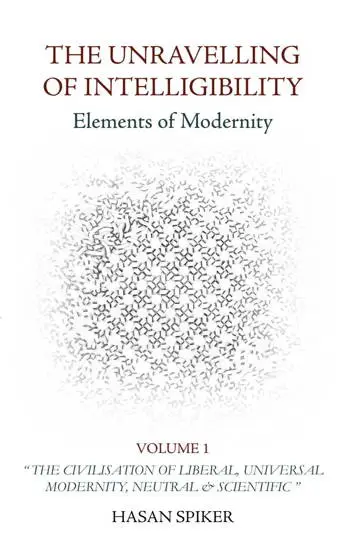
Back-cover text:
The intelligibility of Western thought is unravelling, and the same is true of its attendant societal structures; indeed, they are in the final stages of unravelment. We are now entering a historical singularity, within a civilizational phenomenon, modernity, that was already, in any case, sui generis.
This series of books, 'Elements of Modernity' which contribute to a whole entitled "The Unravelling of Intelligibility", will demonstrate how and why this is taking place. As the volumes in this series unfold, we will see how this stubborn self-erosion has been carried out throughout the history of modernity, as also in key areas of contemporary life: in urban environment and interpersonal relationships, progress and the self-creating individual, immanentism and the intelligibility of nature, faith and reason, 'science', gender and family, power politics, and postcolonialism.
The five 'bifurcations' or 'severances' of Christian and post-Christian civilization constitute the central explanatory framework through which this unravelling is examined and explicated. These bifurcations are: the severance of law and spirit, which emerges in Pauline Christianity; the severance of spiritual power and temporal power in the early Middle Ages; the severance of faith and reason in the later Middle Ages; and in early modernity, the twin severances of natural world and knowing subject, and that of morality and ontology.
IN THIS FIRST ELEMENT
In volume 1, Spiker explores the purported 'universality' and 'neutrality' of the post-Enlightenment system, which has been exported around the world so successfully that today, it is direct descendants of the nations that suffered under colonialism who are most often found to be its most uncompromising devotees, insisting that the neutral, universal Civilisation is no longer 'Western' but has become simply 'modern'. The five severances are then introduced, and their explanatory power is demonstrated through an analysis of the contemporary unravelling of urban environment, craft, and interpersonal relationships.
Cover illustration: Lateefa Spiker
NEW ANDALUS PRESS
↩
So what Brad Gregory is fundamentally saying is that the reformation had these unintended consequences, unintended for the reformers who would be horrified, namely this totalising secularization of society.
And this state of affairs, (as Brad Gregory memorably sums it up) where the supreme value of modern civilisation or modern liberal civilisation is individual free choice, per se, regardless of what is chosen, it doesn't matter what you choose, that has to be protected unquestionably, you can choose anything, as long as it doesn't hurt anyone else.
And then obviously you have this very narrow definition of harm, it doesn't include spiritual or moral harm. That would be to cramp (put limits on) people's freedom, (and they say) no, it's an objective criterion for spiritual or moral harm, but no, that's arbitrary, that's your own inclination, your own identity, your own construction.
I think one of the fundamental reasons why the Muslim critique [of the Lutheran Reformation and its ensuing societal upheavals] is so much more powerful, because we aren't the religion that gave rise to Protestantism and [these negative] events in the modern world [which happened] because of the fundamental structural failings that existed within the Roman Catholic Church.
[Their] kind of fixed or feudal hierarchy, which is kind of set in stone, which allowed for this arbitrary power of the Catholic Church to reign supreme over peoples' lives, [together with] the many abuses that took place in the church, famously with the indulgences, to get time off [from Hell with a] small donation.
↩
From the preface of THE UNRAVELLING OF INTELLIGIBILITY - Elements of Modernity: Volume One:
"The Civilisation of Liberal, Universal Modernity, Neutral & Scientific"
- sui generis: unique, of its own kind.
- intelligibility: the capacity of something to be understood or grasped by the intellect, as opposed to the senses
↩
The original meaning of "intelligible" was of that apprehended by the intellect as opposed to the senses, for example Plato (in Latin translations) talks about intelligibles (forms) vs sensibles (things), see Karl's Plato’s Two World Theory, and Aristotle's use is similar.
Source: Conifold
What is the philosophical notion of "intelligibility"?
↩
-page from 2025-09-26 1447 AH 
